- Search Popular SearchesCritical thinkingPhilosophyEmotional IntelligenceFree Will Latest Videos Latest Articles
-
Topics
Philosophy
- Ethics
- Religion
- Flourishing
- Knowledge
- Philosophy of Science
- Philosophy of Art
- Language
- Political Theory
- Identity
- Meaning & Purpose
Science & Tech
- Physics
- Biology
- Aerospace
- Health
- Geology
- Computing
- Engineering
- Energy
- Biotechnology
Mind & Behavior
- Psychology
- Neuroscience
- Decision-Making
- Mental Health
- Consciousness
- Emotional Intelligence
- Personality
- Relationships
- Parenting
Business
- Entrepreneurship
- Leadership
- Finance
- Marketing
- Innovation
- Strategy
- Management
- Artificial Intelligence
- Startups
- Economics
History & Society
- History
- Literature
- Art
- Music
- Film
- Progress
- Culture
- Sociology
- Policy
- Geopolitics
-
Videos
Latest Videos
 Is there a Planet B? An astrophysicist answers.
with
Sara Seager
Is there a Planet B? An astrophysicist answers.
with
Sara Seager
 What nihilism acknowledges that other philosophies don’t
with
Alex O’Connor
What nihilism acknowledges that other philosophies don’t
with
Alex O’Connor
 Steven Pinker: The mechanics of trust in money and relationships
with
Steven Pinker
Steven Pinker: The mechanics of trust in money and relationships
with
Steven Pinker
 The computing revolution that secretly began in 1776
with
David Alan Grier
The computing revolution that secretly began in 1776
with
David Alan Grier
 How the Industrial Revolution invented modern computing
with
David Alan Grier
How the Industrial Revolution invented modern computing
with
David Alan Grier
 Why modern fitness culture misunderstands human bodies
with
Daniel Lieberman
See All
Why modern fitness culture misunderstands human bodies
with
Daniel Lieberman
See All
-
Columns
 Mini Philosophy
A philosophy column for personal reflection.
Mini Philosophy
A philosophy column for personal reflection.
 Starts With A Bang
An astrophysics column on big questions and our universe.
Starts With A Bang
An astrophysics column on big questions and our universe.
 Books
A literature column to feed your curiosity.
Books
A literature column to feed your curiosity.
 The Long Game
A business column on long-term thinking.
The Long Game
A business column on long-term thinking.
 Strange Maps
A geography column on history and society.
Strange Maps
A geography column on history and society.
 The Well
A collection of essays and videos on life’s biggest questions.
The Well
A collection of essays and videos on life’s biggest questions.
 13.8
A column at the intersection of science and culture.
13.8
A column at the intersection of science and culture.
-
Classes
Featured Classes
 Members
6 videos
Transform Your Organization with AI
Daphne Koller
Founder and CEO of insitro.
Members
6 videos
Transform Your Organization with AI
Daphne Koller
Founder and CEO of insitro.
 Members
10 videos
Unlocking Your Team’s Hidden Potential
Adam Grant
Organizational psychologist and author
Members
10 videos
Unlocking Your Team’s Hidden Potential
Adam Grant
Organizational psychologist and author
 Members
6 videos
The Secrets of Unreasonable Hospitality
Will Guidara
Restaurateur and Author, Unreasonable Hospitality
Members
6 videos
The Secrets of Unreasonable Hospitality
Will Guidara
Restaurateur and Author, Unreasonable Hospitality
 Members
12 videos
How to Afford Anything
Paula Pant
Host, Afford Anything Podcast, Afford Anything
Members
12 videos
How to Afford Anything
Paula Pant
Host, Afford Anything Podcast, Afford Anything
 Members
7 videos
True Ingredients of Successful Leadership
Atul Gawande
Professor and author
Members
7 videos
True Ingredients of Successful Leadership
Atul Gawande
Professor and author
 Members
8 videos
Productivity for Mortals
Oliver Burkeman
Author, “Meditations for Mortals”
Browse
Members
8 videos
Productivity for Mortals
Oliver Burkeman
Author, “Meditations for Mortals”
Browse
-
More
- About Big Think
- Work with Us
- Newsletters
- Monthly Issues
- Events
- Careers
- Our Mission
- Get Big Think+ for Business
- Freethink Media
- View our Twitter (X) feed View our Youtube channel View our Instagram feed View our Substack feed
-
My account
- My Classes
- My Account
- My List
- BT+ for my Business
- Sign Out
- Membership
-
Topics
Back
Philosophy
- Ethics
- Religion
- Flourishing
- Knowledge
- Philosophy of Science
- Philosophy of Art
- Language
- Political Theory
- Identity
- Meaning & Purpose
Science & Tech
- Physics
- Biology
- Aerospace
- Health
- Geology
- Computing
- Engineering
- Energy
- Biotechnology
Mind & Behavior
- Psychology
- Neuroscience
- Decision-Making
- Mental Health
- Consciousness
- Emotional Intelligence
- Personality
- Relationships
- Parenting
Business
- Entrepreneurship
- Leadership
- Finance
- Marketing
- Innovation
- Strategy
- Management
- Artificial Intelligence
- Startups
- Economics
History & Society
- History
- Literature
- Art
- Music
- Film
- Progress
- Culture
- Sociology
- Policy
- Geopolitics
-
Videos
Back
Latest Videos
Is there a Planet B? An astrophysicist answers.
30 years ago, we didn’t know other stars had planets orbiting them. Now, we may be on the verge of...
What nihilism acknowledges that other philosophies don’t
"The thing that the nihilist recognizes is that the values he or she holds are not grounded in anything other...
Steven Pinker: The mechanics of trust in money and relationships
"There is a big, powerful idea floating around linguistics and philosophy and economics and game theory."
The computing revolution that secretly began in 1776
"In the process of mapping the heavens, it doesn't take long to realize the data problem they generated."
How the Industrial Revolution invented modern computing
"The process of systematizing, correcting errors, finding approximations, and making them work as civil systems that was what really drove...
Why modern fitness culture misunderstands human bodies
"It's this modern idea of doing voluntary discretionary, physical activity for the sake of health and fitness."
 Why even the healthiest people hit a wall at age 70
"By keeping people biologically younger, we can enjoy a longer health span, a longer period of healthy life where we're...
Why even the healthiest people hit a wall at age 70
"By keeping people biologically younger, we can enjoy a longer health span, a longer period of healthy life where we're...
 The biggest myth about aging, according to science
"This will help people take meaningful steps to slow the rate of aging and increase what we call their health...
The biggest myth about aging, according to science
"This will help people take meaningful steps to slow the rate of aging and increase what we call their health...
-
Columns
Back
Columns
Mini Philosophy
A philosophy column for personal reflection.
Starts With A Bang
An astrophysics column on big questions and our universe.
Books
A literature column to feed your curiosity.
The Long Game
A business column on long-term thinking.
Strange Maps
A geography column on history and society.
The Well
A collection of essays and videos on life’s biggest questions.
13.8
A column at the intersection of science and culture.
-
Classes
Back
Featured Classes
Members
6 videos
Transform Your Organization with AI
Daphne Koller
Founder and CEO of insitro.
Members
10 videos
Unlocking Your Team’s Hidden Potential
Adam Grant
Organizational psychologist and author
Members
6 videos
The Secrets of Unreasonable Hospitality
Will Guidara
Restaurateur and Author, Unreasonable Hospitality
Members
12 videos
How to Afford Anything
Paula Pant
Host, Afford Anything Podcast, Afford Anything
Members
7 videos
True Ingredients of Successful Leadership
Atul Gawande
Professor and author
Members
8 videos
Productivity for Mortals
Oliver Burkeman
Author, “Meditations for Mortals”
-
My Account
Back
- My Classes
- My Account
- My List
- BT+ for my Business
- Sign Out
- Sign In
- Membership
-
More
Back
- About Big Think
- Work with Us
- Newsletters
- Monthly Issues
- Events
- Careers
- Our Mission
- Get Big Think+ for Business
- Freethink Media
- View our Twitter (X) feed View our Youtube channel View our Instagram feed View our Substack feed
The Universe formed stars, galaxies, and even galaxy clusters extremely early on in our cosmos. This new marvel is one more JWST surprise.
by Ethan Siegel February 2, 2026 This protocluster of galaxies, known as JADES-ID1, is the 4th earliest, most distant protocluster of galaxies ever identified, as its member galaxies are shown with circles in this JWST image. Its hot, X-ray emitting gas, as found complementarily with Chandra, marks the earliest cluster to show this characteristic X-ray glow.
Credit: Á. Bogdán et al., Nature, 2026
Key Takeaways- Although our Universe was born relatively uniform, with only tiny density imperfections, those imperfections eventually grew into stars, galaxies, galaxy clusters, and the grand cosmic web.
- While JWST has revealed a surprisingly large number of early, bright galaxies, it’s also revealed a few surprises about the earliest galaxy clusters: finding a few very early, very massive ones that defy expectations.
- With the power of JWST’s infrared views and Chandra’s X-ray capabilities, we’ve just found the earliest protocluster of galaxies with significant X-ray emissions, indicating more than a trillion solar masses worth of hot gas. Here’s what it means.

An astrophysics column on big questions and our universe.
NewsletterThe Hubble Space Telescope displayed what the Universe looks like.
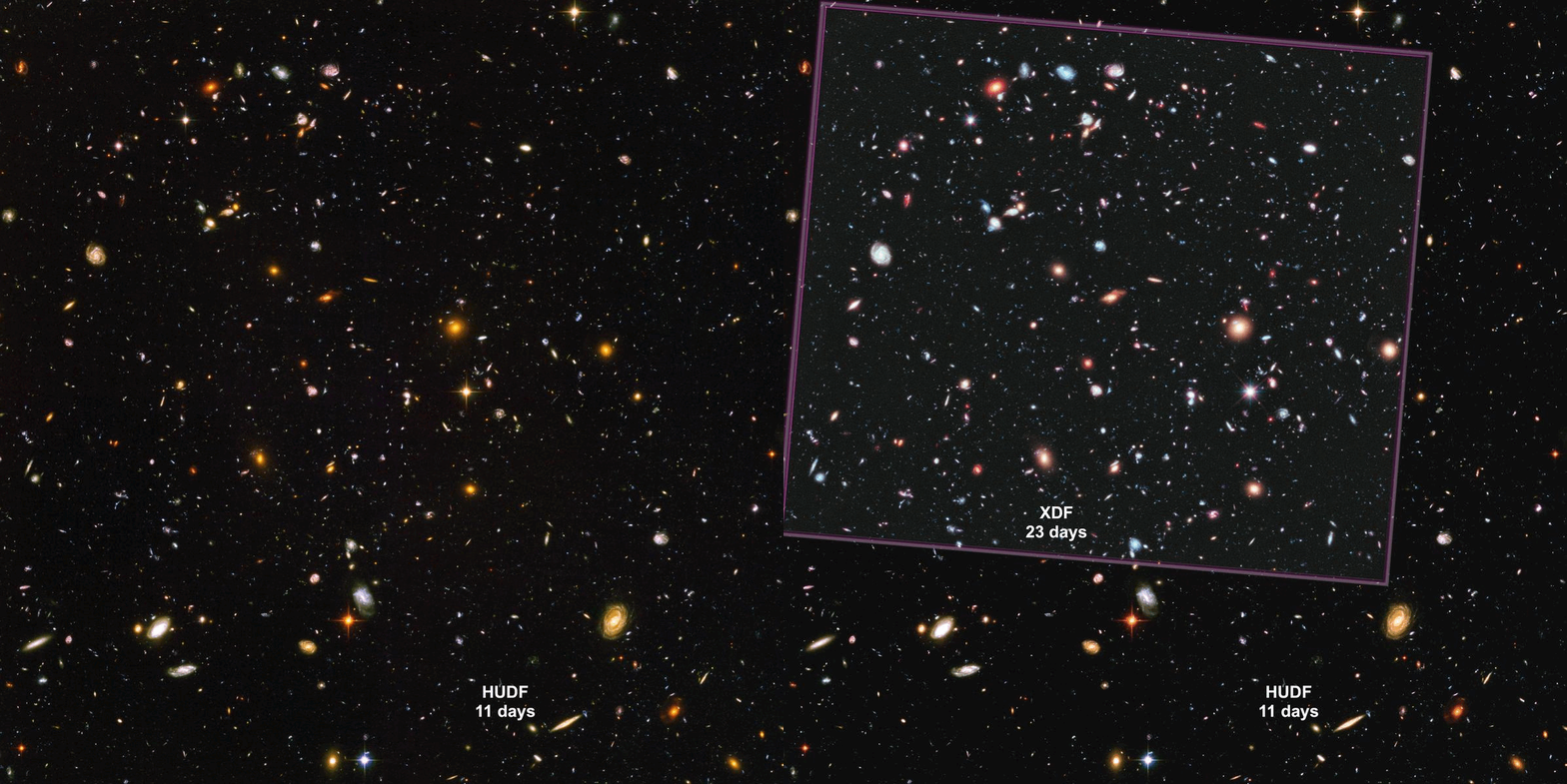 Over the course of 50 days, with a total of over 2 million seconds of observing time (the equivalent of 23 complete days), the Hubble eXtreme Deep Field (XDF) was constructed from a portion of the prior Hubble Ultra Deep Field image. Combining light from ultraviolet through visible light and out to Hubble’s near-infrared limit, the XDF represents humanity’s deepest view of the cosmos: a record that stood until the JWST’s first deep field was released on July 11, 2022.
Credit: NASA, ESA, G. Illingworth, D. Magee, and P. Oesch (University of California, Santa Cruz), R. Bouwens (Leiden University), and the HUDF09 Team
Over the course of 50 days, with a total of over 2 million seconds of observing time (the equivalent of 23 complete days), the Hubble eXtreme Deep Field (XDF) was constructed from a portion of the prior Hubble Ultra Deep Field image. Combining light from ultraviolet through visible light and out to Hubble’s near-infrared limit, the XDF represents humanity’s deepest view of the cosmos: a record that stood until the JWST’s first deep field was released on July 11, 2022.
Credit: NASA, ESA, G. Illingworth, D. Magee, and P. Oesch (University of California, Santa Cruz), R. Bouwens (Leiden University), and the HUDF09 Team
Its successor, JWST, now reveals how the Universe grew up.
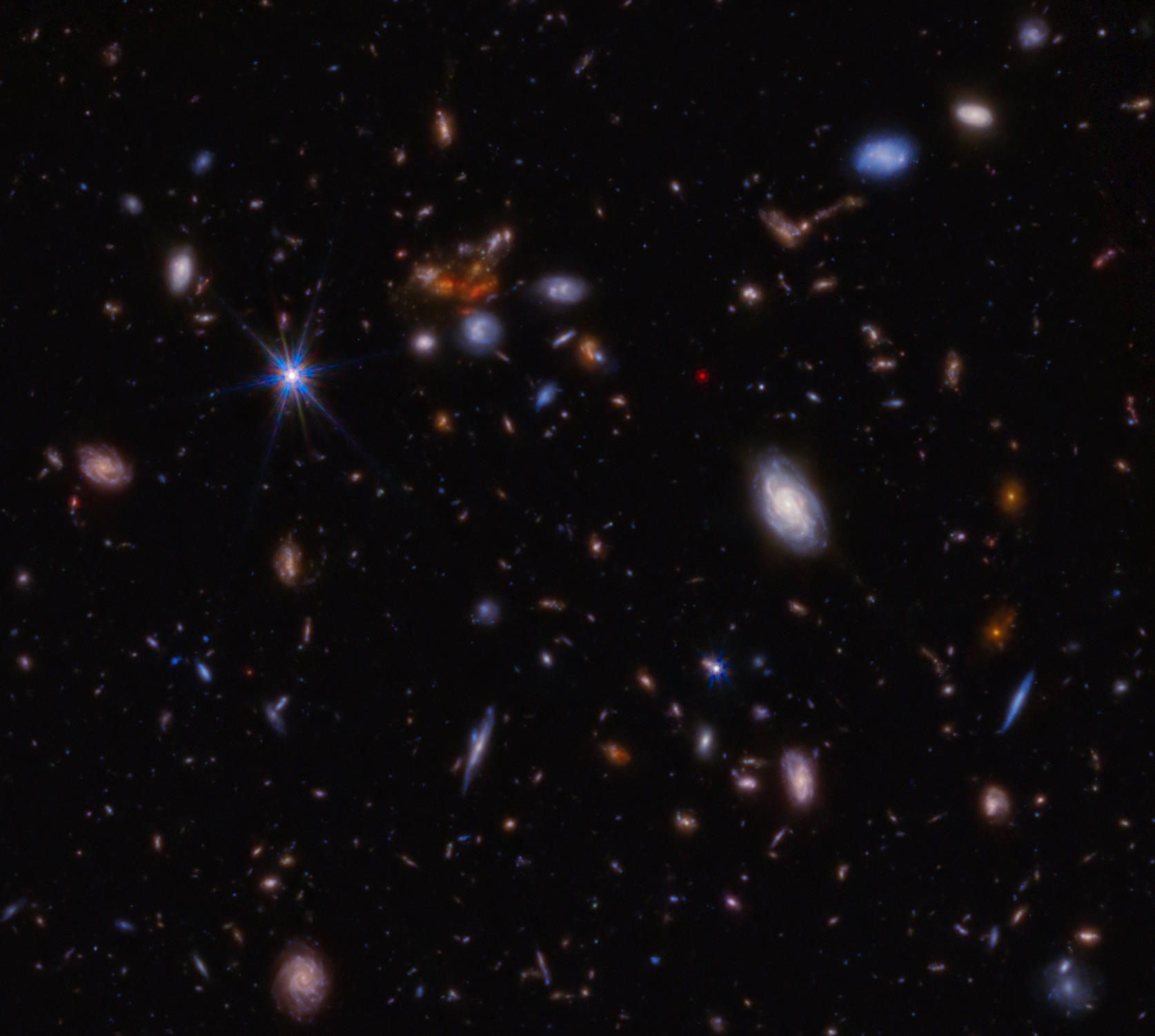 This tiny fraction of the JADES survey area, taken with JWST’s NIRCam instrument, showcases relatively nearby galaxies in detail, galaxies at intermediate distances that appear grouped together, and even ultra-distant galaxies that may be interacting or forming stars, despite their faint nature and red appearance. Even though we’ve been performing JWST science for over two years, we are only beginning to probe the full richness of the cosmos with JWST.
Credit: NASA, ESA, CSA, STScI, B. Robertson (UC Santa Cruz), B. Johnson (CfA), S. Tacchella (Cambridge), P. Cargile (CfA)
This tiny fraction of the JADES survey area, taken with JWST’s NIRCam instrument, showcases relatively nearby galaxies in detail, galaxies at intermediate distances that appear grouped together, and even ultra-distant galaxies that may be interacting or forming stars, despite their faint nature and red appearance. Even though we’ve been performing JWST science for over two years, we are only beginning to probe the full richness of the cosmos with JWST.
Credit: NASA, ESA, CSA, STScI, B. Robertson (UC Santa Cruz), B. Johnson (CfA), S. Tacchella (Cambridge), P. Cargile (CfA)
Galaxies formed and grew massive swiftly: requiring under 300 million years.
 This image shows a three-filter NIRCam view of galaxy MoM-z14: the new record holder (as of May 16, 2025) for the most distant galaxy ever discovered. Invisible at wavelengths below 1.8 microns, JWST has measured its spectrum and detected several emission lines, cementing its status as arising from when the Universe was a mere 282 million years old.
Credit: R.P. Naidu et al., Open Journal of Astrophysics (submitted)/arXiv:2505.11263, 2025
This image shows a three-filter NIRCam view of galaxy MoM-z14: the new record holder (as of May 16, 2025) for the most distant galaxy ever discovered. Invisible at wavelengths below 1.8 microns, JWST has measured its spectrum and detected several emission lines, cementing its status as arising from when the Universe was a mere 282 million years old.
Credit: R.P. Naidu et al., Open Journal of Astrophysics (submitted)/arXiv:2505.11263, 2025
Larger-scale, more massive structures, like galaxy clusters, take longer.
 This image shows the huge galaxy cluster MACS J1149.5+223, whose light took over 5 billion years to reach us. The huge mass of the cluster is bending the light from more distant objects. The light from these objects has been magnified and distorted due to gravitational lensing. The same effect is creating multiple images of the same distant objects. Meanwhile, the central location of the cluster clearly shows intracluster light: a remarkable tracer of dark matter.
Credit: NASA, ESA, S. Rodney (John Hopkins University, USA) and the FrontierSN team; T. Treu (University of California Los Angeles, USA), P. Kelly (University of California Berkeley, USA) and the GLASS team; J. Lotz (STScI) and the Frontier Fields team; M. Postman (STScI) and the CLASH team; and Z. Levay (STScI)
This image shows the huge galaxy cluster MACS J1149.5+223, whose light took over 5 billion years to reach us. The huge mass of the cluster is bending the light from more distant objects. The light from these objects has been magnified and distorted due to gravitational lensing. The same effect is creating multiple images of the same distant objects. Meanwhile, the central location of the cluster clearly shows intracluster light: a remarkable tracer of dark matter.
Credit: NASA, ESA, S. Rodney (John Hopkins University, USA) and the FrontierSN team; T. Treu (University of California Los Angeles, USA), P. Kelly (University of California Berkeley, USA) and the GLASS team; J. Lotz (STScI) and the Frontier Fields team; M. Postman (STScI) and the CLASH team; and Z. Levay (STScI)
The earliest mature, fully-fledged cluster is CL J1001+0220.
 This X-ray/infrared composite image shows galaxy cluster CL J1001+0220, the earliest known mature, X-ray emitting galaxy cluster. Although this was the earliest known galaxy cluster of any type in 2016, several younger protoclusters have since been identified. It remains the earliest mature galaxy cluster known today, even in the JWST era.
Credits: X-ray: NASA/CXC/Université Paris/T.Wang et al; Infrared: ESO/UltraVISTA; Radio: ESO/NAOJ/NRAO/ALMA
This X-ray/infrared composite image shows galaxy cluster CL J1001+0220, the earliest known mature, X-ray emitting galaxy cluster. Although this was the earliest known galaxy cluster of any type in 2016, several younger protoclusters have since been identified. It remains the earliest mature galaxy cluster known today, even in the JWST era.
Credits: X-ray: NASA/CXC/Université Paris/T.Wang et al; Infrared: ESO/UltraVISTA; Radio: ESO/NAOJ/NRAO/ALMA
Simulations predict such clusters to appear late: after 2-3 billion years.
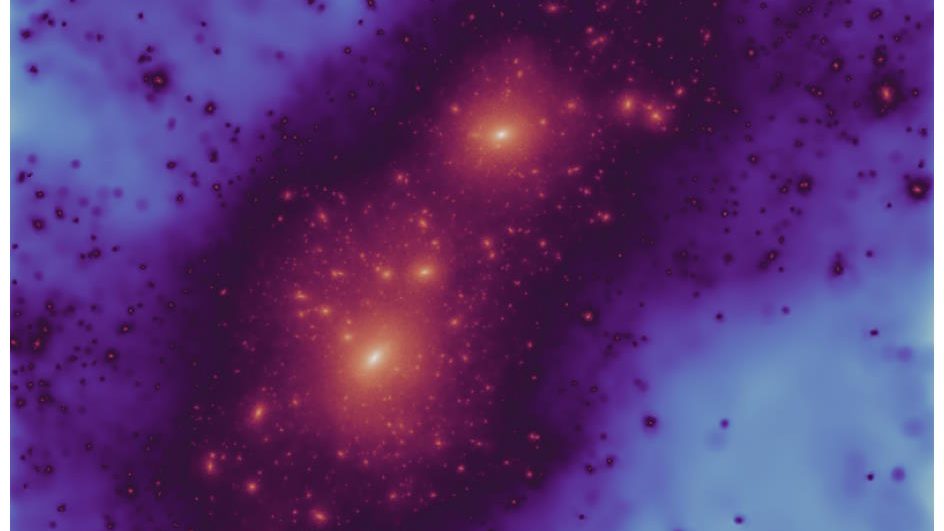 The SIBELIUS project, which simulates galaxies and structures beyond the local Universe, is part of the Virgo Consortium that attempts to use cosmological simulations to reproduce features of galaxies, groups, and clusters that are seen all across the Universe. By using a mix of theory, observations, and simulations, astrophysicists can better understand the nature of dark matter in our cosmos. The formation of large galaxy clusters generally requires long timescales and initially large overdensities, with the largest initial overdensities requiring less time to form clusters.
Credit: Virgo Consortium/SIBELIUS project
The SIBELIUS project, which simulates galaxies and structures beyond the local Universe, is part of the Virgo Consortium that attempts to use cosmological simulations to reproduce features of galaxies, groups, and clusters that are seen all across the Universe. By using a mix of theory, observations, and simulations, astrophysicists can better understand the nature of dark matter in our cosmos. The formation of large galaxy clusters generally requires long timescales and initially large overdensities, with the largest initial overdensities requiring less time to form clusters.
Credit: Virgo Consortium/SIBELIUS project
However, protoclusters, or still-forming galaxy clusters, appear far earlier.
 These two galaxy protoclusters, z66OD (at a redshift of 6.6) and z57OD (at a redshift of 5.7) are overdense collections of galaxies on large, cluster-like scales, with 12 and 44 galaxies (at least) inside of them, respectively. The blue blobs show the reconstructed mass distribution of these protoclusters, whose light comes from 830 million and 1.0 billion years after the Big Bang.
Credit: Y. Harikane et al., Astrophysical Journal, 2019
These two galaxy protoclusters, z66OD (at a redshift of 6.6) and z57OD (at a redshift of 5.7) are overdense collections of galaxies on large, cluster-like scales, with 12 and 44 galaxies (at least) inside of them, respectively. The blue blobs show the reconstructed mass distribution of these protoclusters, whose light comes from 830 million and 1.0 billion years after the Big Bang.
Credit: Y. Harikane et al., Astrophysical Journal, 2019
A 2019 study revealed protoclusters z66OD and z57OD: with at least 12 and 44 member galaxies, respectively.
 This galaxy protocluster, known as z66OD, contains 12 independent galaxies all at the same redshift: z=6.6. Its light comes to us from just 830 million years after the Big Bang. Prior to JWST, this protocluster was the earliest collection of galaxies in the same region of space ever known. The blue shading shows the estimated extent of the protocluster.
Credit: NAOJ/Y. Harikane et al., Astrophysical Journal, 2019
This galaxy protocluster, known as z66OD, contains 12 independent galaxies all at the same redshift: z=6.6. Its light comes to us from just 830 million years after the Big Bang. Prior to JWST, this protocluster was the earliest collection of galaxies in the same region of space ever known. The blue shading shows the estimated extent of the protocluster.
Credit: NAOJ/Y. Harikane et al., Astrophysical Journal, 2019
Then, in 2023, JWST spotted the earliest known protocluster of galaxies assembling: A2744z7p9OD.
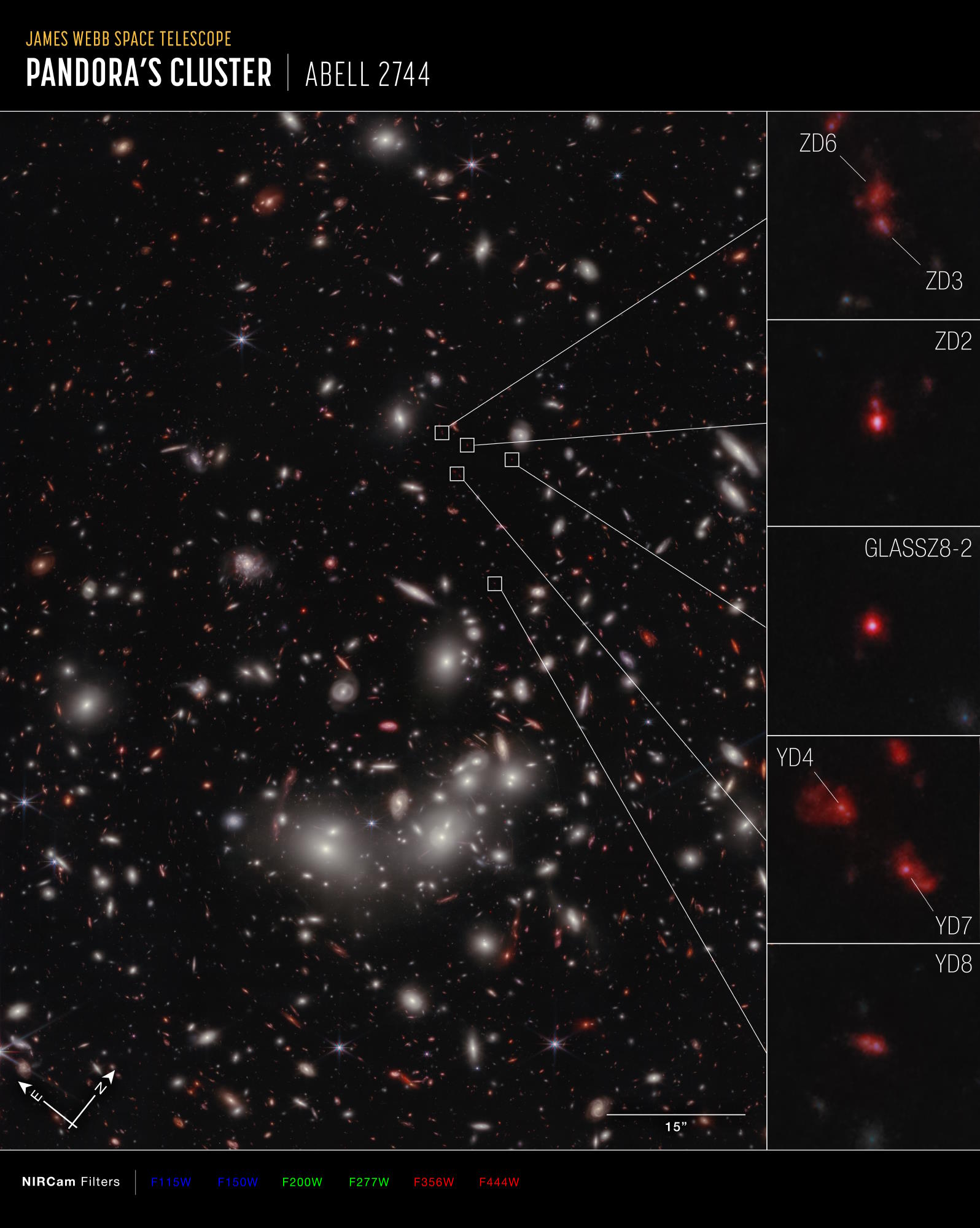 The galaxies that are members of the identified protocluster A2744z7p9OD are shown here, outlined atop their positions in the JWST view of galaxy cluster Abell 2744. At just 650 million years after the Big Bang, it’s the oldest protocluster of galaxies ever identified. This is early, but is consistent with simulations of when the earliest protoclusters should emerge from the most initially overdense regions.
Credit: NASA, ESA, CSA, Takahiro Morishita (IPAC); Processing: Alyssa Pagan (STScI)
The galaxies that are members of the identified protocluster A2744z7p9OD are shown here, outlined atop their positions in the JWST view of galaxy cluster Abell 2744. At just 650 million years after the Big Bang, it’s the oldest protocluster of galaxies ever identified. This is early, but is consistent with simulations of when the earliest protoclusters should emerge from the most initially overdense regions.
Credit: NASA, ESA, CSA, Takahiro Morishita (IPAC); Processing: Alyssa Pagan (STScI)
With seven large, bright member galaxies just 650 million years after the Big Bang, it remains the youngest protocluster identified.
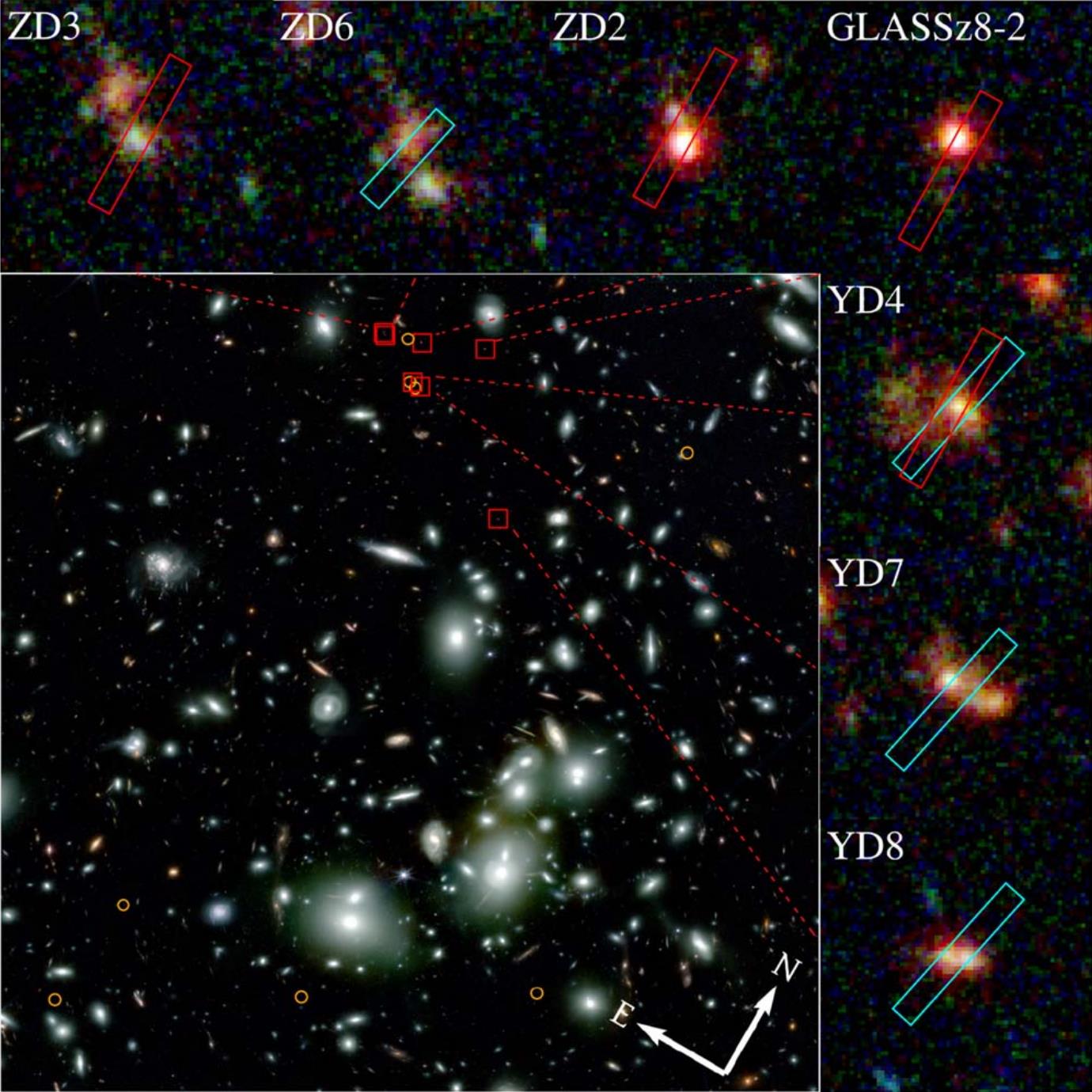 This image shows the view of JWST’s NIRCam instrument as it looked at galaxy cluster Abell 2744 and revealed a number of galaxies that are members of a protocluster. The red squares show several of the galaxies for which spectroscopic measurements were obtained; the orange circles are photometric galaxy candidates that may yet turn out to be part of this cluster. Small, low-mass galaxies form earlier; larger, evolved galaxies and galaxy clusters only appear at later times.
Credit: T. Morishita et al., ApJL, 2023
This image shows the view of JWST’s NIRCam instrument as it looked at galaxy cluster Abell 2744 and revealed a number of galaxies that are members of a protocluster. The red squares show several of the galaxies for which spectroscopic measurements were obtained; the orange circles are photometric galaxy candidates that may yet turn out to be part of this cluster. Small, low-mass galaxies form earlier; larger, evolved galaxies and galaxy clusters only appear at later times.
Credit: T. Morishita et al., ApJL, 2023
However, one hallmark of mature clusters is missing from these protoclusters: hot, X-ray emitting gas.
 This image composite shows the full-field of a large galaxy cluster within the COSMOS-Web survey, using a combination of JWST NIRCam and Hubble infrared data, with X-ray data from the Chandra X-ray telescope overlaid in violet. The X-rays are evidence from the heated gas that occurs when galaxy clusters merge or experience major disruptive events.
Credit: ESA/Webb, NASA & CSA, G. Gozaliasl, A. Koekemoer, M. Franco, and the COSMOS-Web team
This image composite shows the full-field of a large galaxy cluster within the COSMOS-Web survey, using a combination of JWST NIRCam and Hubble infrared data, with X-ray data from the Chandra X-ray telescope overlaid in violet. The X-rays are evidence from the heated gas that occurs when galaxy clusters merge or experience major disruptive events.
Credit: ESA/Webb, NASA & CSA, G. Gozaliasl, A. Koekemoer, M. Franco, and the COSMOS-Web team
However, the discovery of the fourth earliest galaxy protocluster, JADES-ID1, changes all of that.
 A whopping 66 potential member galaxies have been identified in galaxy protocluster JADES-ID1, identified with data obtained with deep JWST imagery. A large overdensity this rare and this early, just 1 billion years after the Big Bang (at z = 5.68), is a remarkable find.
Credit: Á. Bogdán et al., Nature, 2026
A whopping 66 potential member galaxies have been identified in galaxy protocluster JADES-ID1, identified with data obtained with deep JWST imagery. A large overdensity this rare and this early, just 1 billion years after the Big Bang (at z = 5.68), is a remarkable find.
Credit: Á. Bogdán et al., Nature, 2026
Alongside 66 potential member galaxies, X-ray emitting gas was spotted by NASA’s Chandra.
 This animation shows a more full field of the early protocluster JADES-ID1 from within the JWST Advanced Deep Extragalactic Survey field. The X-ray data, from NASA’s Chandra X-ray observatory, is overlaid in this animation in blue, showcasing the characteristic X-ray emission of hot gas in galaxy clusters.
Credits: X-ray: NASA/CXC/CfA/Á Bogdán; Infrared: NASA/ESA/CSA/STScI; Image Processing: NASA/CXC/SAO/P. Edmonds and L. Frattare; Animation: E. Siegel
This animation shows a more full field of the early protocluster JADES-ID1 from within the JWST Advanced Deep Extragalactic Survey field. The X-ray data, from NASA’s Chandra X-ray observatory, is overlaid in this animation in blue, showcasing the characteristic X-ray emission of hot gas in galaxy clusters.
Credits: X-ray: NASA/CXC/CfA/Á Bogdán; Infrared: NASA/ESA/CSA/STScI; Image Processing: NASA/CXC/SAO/P. Edmonds and L. Frattare; Animation: E. Siegel
It’s definitively associated with the distant protocluster, with the right spectrum of X-ray energies.
 The white contours show higher-energy X-rays, which shouldn’t come from a protocluster, while the yellow contours show the likelihood of low-energy X-rays, which are present, based on the locations of individually identified protocluster members. The violet circle, indicating the central location of the emitted X-rays, is shown superimposed atop the yellow likelihood map.
Credit: Á. Bogdán et al., Nature, 2026
The white contours show higher-energy X-rays, which shouldn’t come from a protocluster, while the yellow contours show the likelihood of low-energy X-rays, which are present, based on the locations of individually identified protocluster members. The violet circle, indicating the central location of the emitted X-rays, is shown superimposed atop the yellow likelihood map.
Credit: Á. Bogdán et al., Nature, 2026
These X-ray emissions mark the earliest cosmic detection of intracluster heating and virialization.
 This figure represents an X-ray (from Chandra) and infrared (from JWST) composite of the protocluster of galaxies known as JADES-ID1, the earliest galaxy cluster showing signs of heated, virialized gas that emits low-energy (but not high-energy) X-rays. The Universe, as revealed by this protocluster, can grow up remarkably fast.
Credit: X-ray: NASA/CXC/CfA/Á Bogdán; Infrared: NASA/ESA/CSA/STScI; Image Processing: NASA/CXC/SAO/P. Edmonds and L. Frattare
This figure represents an X-ray (from Chandra) and infrared (from JWST) composite of the protocluster of galaxies known as JADES-ID1, the earliest galaxy cluster showing signs of heated, virialized gas that emits low-energy (but not high-energy) X-rays. The Universe, as revealed by this protocluster, can grow up remarkably fast.
Credit: X-ray: NASA/CXC/CfA/Á Bogdán; Infrared: NASA/ESA/CSA/STScI; Image Processing: NASA/CXC/SAO/P. Edmonds and L. Frattare
Containing trillions of solar masses, such evolved, early protoclusters must be cosmically rare.
 Here, the El Gordo galaxy cluster is shown in two unusual ways: where the colors represent the mass density of the diffuse mass component as inferred by gravitational lensing data (colors), while the black contours show the X-ray emissions as measured via the Chandra X-ray telescope. Note that the two maps are very different from one another, indicating that overall mass does not follow the same locations that the normal matter does. Late-time galaxy clusters often emit X-rays, but only one early protocluster, JADES-ID1, has been seen to do so thus far.
Credit: J.M. Diego et al. (PEARLS collaboration), A&A, 2023
Mostly Mute Monday tells an astronomical story in images, visuals, and no more than 200 words.
Ethan SiegelTheoretical astrophysicist and science writer
Full Profile
Related Content
Starts With A BangSupermassive black holes came before stars in ancient galaxies
Such massive, early supermassive black holes have puzzled astronomers for decades. At last, we've finally figured out how they form.
by Ethan Siegel Starts With A Bang
Starts With A Bang podcast #122 – Galaxy evolution and JWST
To learn how our Universe grew up, we have to look at large numbers of galaxies at all distances to find out. Good thing we have JWST!
by Ethan Siegel Starts With A Bang
Ask Ethan: How and when will the Universe die?
As the Universe ages, it continues to gravitate, form stars, and expand. And yet, all this will someday end. Do we finally understand how?
by Ethan Siegel Starts With A Bang
New theory: Could early, supermassive stars explain the Universe?
With several seemingly incompatible observations, cosmology faces many puzzles. Could early, supermassive stars be the unified solution?
by Ethan Siegel Learn from the world's biggest thinkers.
-
Videos
- Latest
- The Big Think Interview
-
Columns
- Mini Philosophy
- Starts with a Bang
- Big Think Books
- The Long Game
- Strange Maps
- 13.8
- The Well
-
Sections
- Philosophy
- Mind & Behavior
- Science & Tech
- Business
- History & Society
-
Classes
- Class Library
-
Subscribe
- Membership
- Free Newsletters
-
About
- Our Mission
- Work with Us
- Contact
- Privacy Policy
- Terms of Sale
- Accessibility
- Careers